Bank of America
2022
From Complex Rules to Simple Decisions
Designing a personalized funding experience that turns a complex system into a simple customer decision
How a new feature turns into more $$$ in the bank for everyone.
Context
Opening an account doesn't mean a customer is ready to use it.
Our team had made significant progress simplifying digital account opening, but we saw an activation gap after acquisition: customers were opening accounts without funding them.
The next step seemed simple: help customers move money into their new account. But the underlying system wasn't simple.
Funding options varied based on customer eligibility, account type, existing relationships, verification status, and platform. Showing every possible option created unnecessary complexity, while hiding too much information could leave customers unsure of what to do.
We needed to turn complex funding logic into a simple customer decision.
Opportunity area
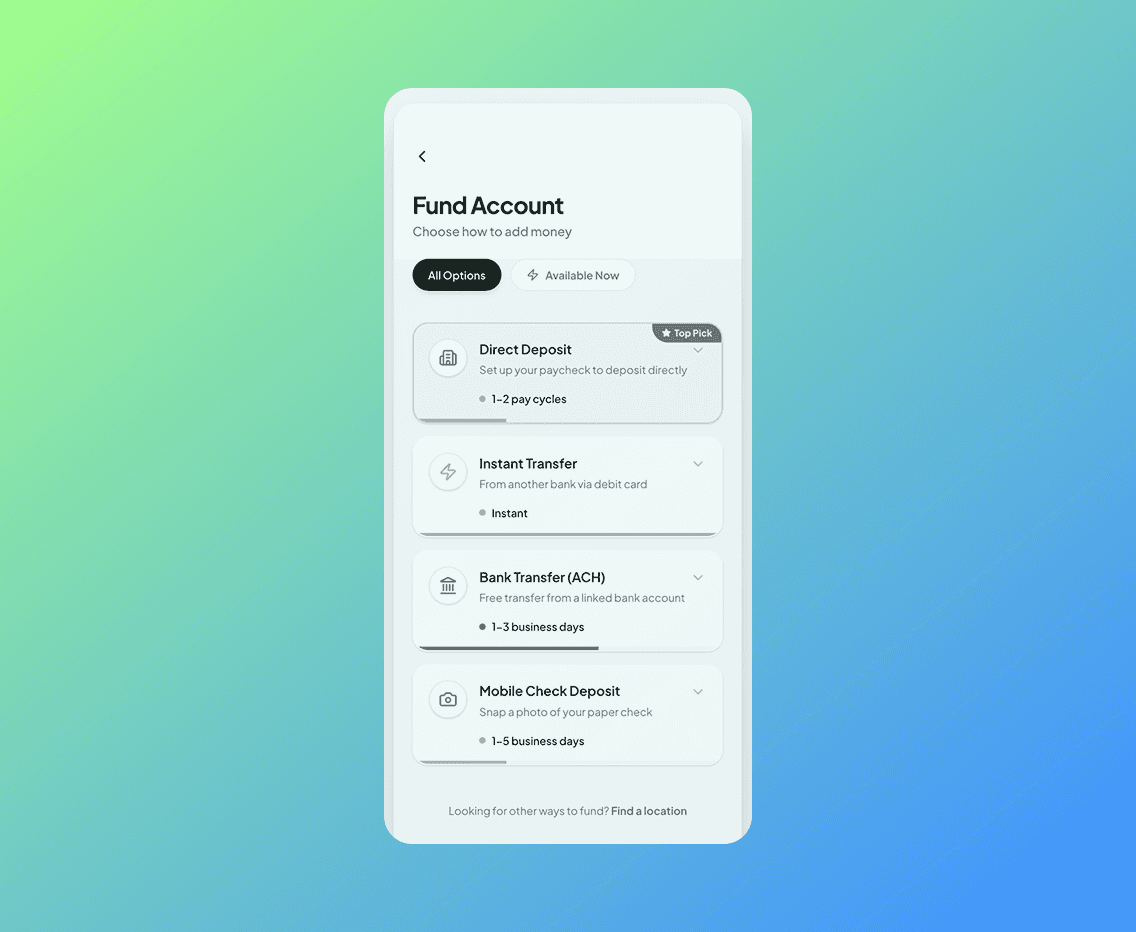
We saw an opportunity to create a dynamic funding module.
Users were presented with options that were sometimes unavailable or poorly explained, leading to hesitation, confusion around transfer timing and fees, and increased drop-off at a pivotal moment. This disconnect between account creation and first deposit limited product adoption and weakened the onboarding journey at its most important stage.
How might we make funding feel personalized and effortless while creating a flexible system that could scale with new funding methods?
How to solve for:
Problem 2
The process felt fragmented, options were unclear, and completion rates lagged.
Problem 3
“How might we make funding intuitive, fast, and personalized no matter where customers start?”
Design Strategy
Closing the activation gap
To close the activation gap between account creation and first deposit, the strategy focused on transforming funding from a static list of options into a dynamic, personalized decision experience. The goal was to reduce friction, increase clarity, and guide users confidently through their first deposit.
Surfacing the available options, tailored for the user to pick from and explaining how each works:
The TL;DR
We had the opportunity to go from complex funding logic → to a modular experience system
The funding experience had to account for things like:
Different funding methods
Different account/product types
Eligibility rules
Different states and statuses
Amount limits
User actions and dependencies
Backend decisions that weren't naturally understandable to customers
Instead of designing each scenario as a one-off flow, I created a system of reusable patterns and rules that could adapt to those variables.
The design problem
If we designed each scenario independently, every new funding condition would require another flow, another component, or another exception.
The systems insight
I reframed the problem from “How do we design the funding flow?” to “How do we create a funding framework that can adapt to different conditions?”
The solution
I created a modular system of components, states, and interaction patterns that translated complex eligibility logic into understandable customer experiences.
The impact
This gave the team a more consistent funding experience while creating a foundation that could scale across products and future funding scenarios.
Rather than creating separate experiences for every funding scenario, I designed a flexible framework that could accommodate different products, funding methods, and eligibility states.
Ta-dah moment
Designed a module that's reusable, and scalable withing the system.
This ensured consistency, extensibility, and long-term growth support beyond the initial on-boarding flow.
To ensure scalability the funding module is:
Reusable across onboarding and post-onboarding
Built with component-level flexibility
Designed to accommodate future funding methods

Design decision 01
Personalization based on eligibility and availability
Some funding methods were unavailable based on account type, region, or device. The experience lacked prioritization, users didn’t know what to choose. With our Personalization logic, we mapped options to ensure relevance without overwhelming the user.
Confirming and reviewing transfer
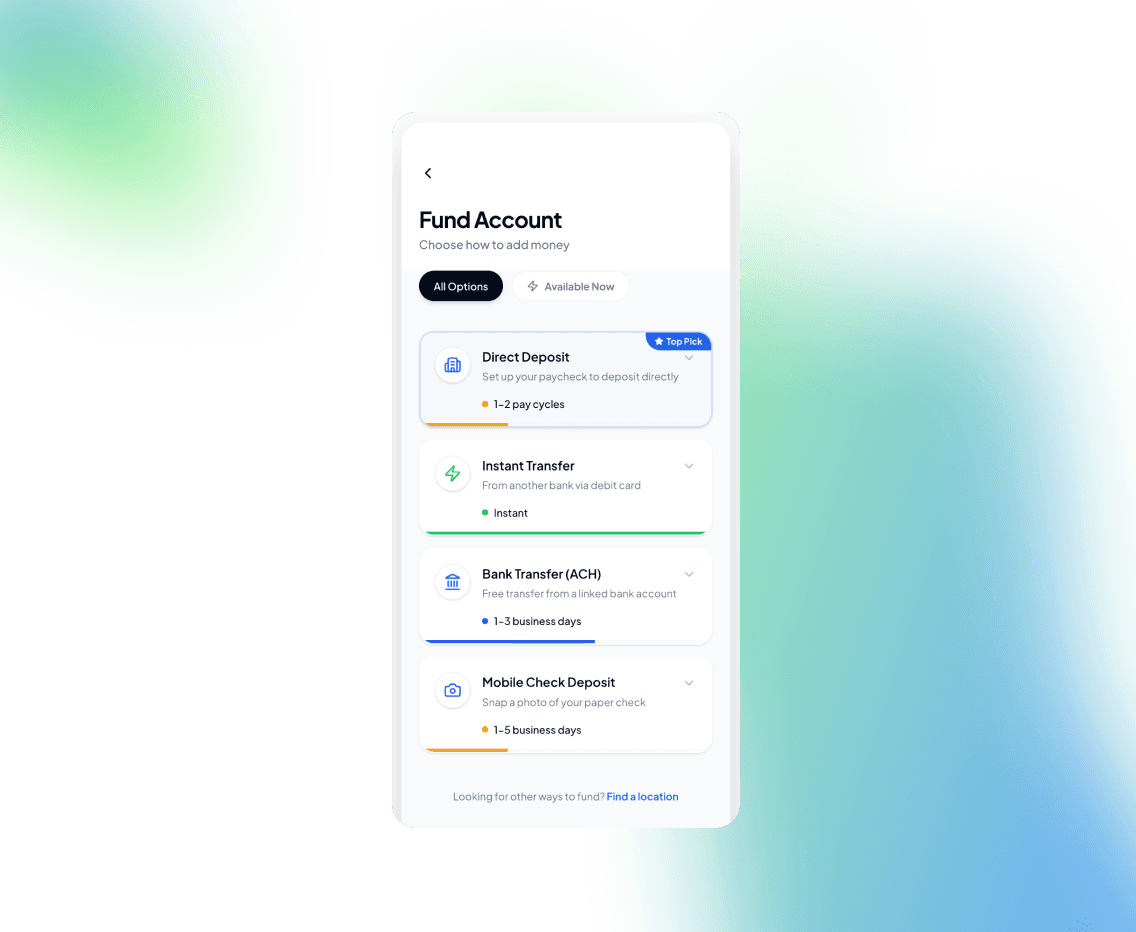
Eligibility-Based Personalization.
The system dynamically determined: Account type KYC Status Linked bank presence Regional restrictions Only eligible funding options were displayed.
Funding methods were adapted by device:
Mobile → Apple Pay / instant linking Desktop → Manual bank transfer Native capabilities prioritized when available This reduced dead ends and cross-device friction.
Design decision 02
Transparent education at the point of decision
Users hesitated because they didn’t understand the details and differences of each type of transaction. We re-framed funding from “pick an option” to “choose what works for you.”
Education panel.
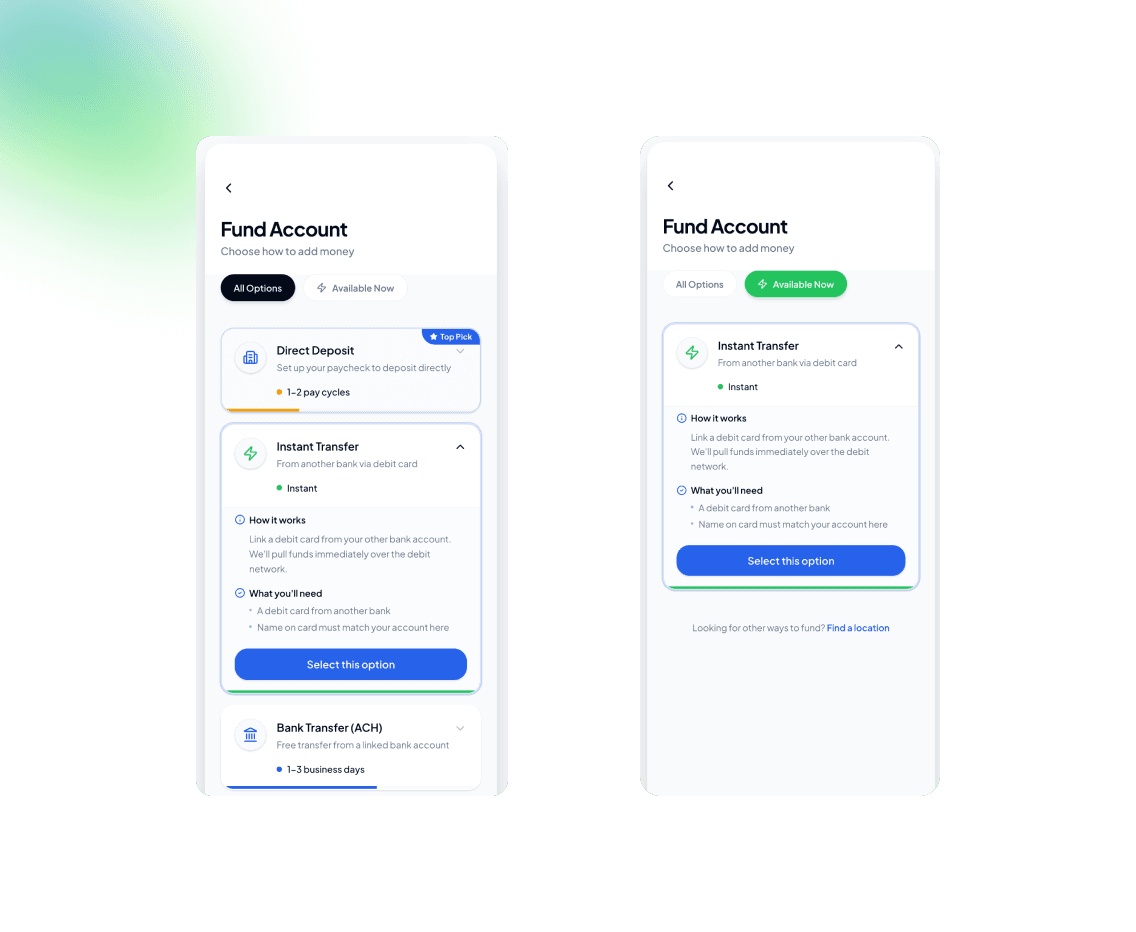
Each funding method included:
Clear description
Transfer speed
Fee transparency
Risk/hold explanations
Visual timeline indicators
Results
This was not simply a UI redesign, but a systems-level intervention within the onboarding ecosystem.
We accounted for backend eligibility logic, cross-platform parity, and compliance requirements while building a modular structure that could scale with future funding methods. By also applying behavioral principles to reduce uncertainty and increase transparency at the activation moment, the feature strengthened the entire onboarding ecosystem , not just a single screen.
The results were clear:
Increased funding completion rate
Improved Day-1 activation
Reduced support tickets related to funding confusion
Enabled faster rollout of new funding methods
Where I would go next
The future is predictive.
I started working on what it would mean to be completely predictive. Looking ahead, I would enhance the experience by introducing predictive default recommendations that surface the most relevant funding option based on user context and behavior. Smart prioritization could dynamically reorder options to reflect likelihood of completion, reducing decision friction. I would also explore progress-based nudges to gently prompt users who begin but do not complete funding, reinforcing momentum without creating pressure.